 English
 Español
 العربية
By Bange Machine Engineering Team | PET Blow Molding Machine Solutions
The PET blow molding industry is undergoing a structural transformation. The forces driving it are not speculative—they are already visible in the equipment being commissioned today and the specifications being written into 2026 procurement contracts. Energy costs are rising. Recycled content mandates are tightening. The available workforce is less experienced with hydraulic machinery than the generation it replaces. And the margin for production variability is shrinking as lightweighting pushes wall thicknesses toward the limits of material performance.
Three technology trends are converging to address these pressures: all-electric machine architectures, AI-driven quality control systems, and the integration of blow molding equipment into connected factory environments. This analysis examines each trend from an engineering and operational perspective, and explains what they mean for processors evaluating blow molding equipment investments in the 2026–2030 window.
Trend 1: All-Electric Systems and the Energy Economics of Blow Molding
The shift away from hydraulic power in blow molding is no longer a niche preference. It is the dominant direction of new product development. At K 2025 and in the months since, machine builders have introduced all-electric platforms across injection blow, extrusion blow, and stretch blow molding categories, with energy consumption reductions cited as the primary commercial justification [citation:1].
The Numbers Behind the Shift
The energy advantage of all-electric architectures is substantial and measurable. Uniloy’s UIB 129.E injection blow molder, for example, requires only 18 kilowatts under normal operation—up to 60% less energy than comparable hydraulic systems [citation:1][citation:6]. The company’s UCS 35 J.ED Coex3 continuous extrusion shuttle machine uses approximately 40% less energy than a traditional hydraulic shuttle machine [citation:1].
Bekum’s new SmartLine series, built from the ground up as an all-electric platform, claims 30% lower investment cost, 20% less energy use, and 10% less material consumption than comparable machines [citation:1]. These are not marginal improvements. For a processor running multiple blow molding lines across three shifts, a 20–60% reduction in energy consumption per machine translates directly into a lower cost per bottle that compounds over the equipment’s service life.
The energy savings come from several architectural differences. Hydraulic systems run pumps continuously, consuming power even during idle portions of the cycle. All-electric systems draw power only when an axis is moving. Servo-driven clamping, carriage movement, and blow pin actuation eliminate the throttling losses inherent in hydraulic valve control. Regenerative energy recovery systems, such as the one incorporated into Automa by Magic’s AbM series, capture braking energy from servo motors and feed it back into the circuit, further improving efficiency [citation:1].
Beyond Energy: Precision and Repeatability
The secondary benefits of all-electric architecture are equally important for PET blow molding, where dimensional consistency directly determines downstream performance. Electric servo axes provide position control with far greater resolution than hydraulic cylinders. Clamp force repeatability improves, mold closing parallelism is more precisely maintained, and the variability introduced by hydraulic fluid temperature changes is eliminated.
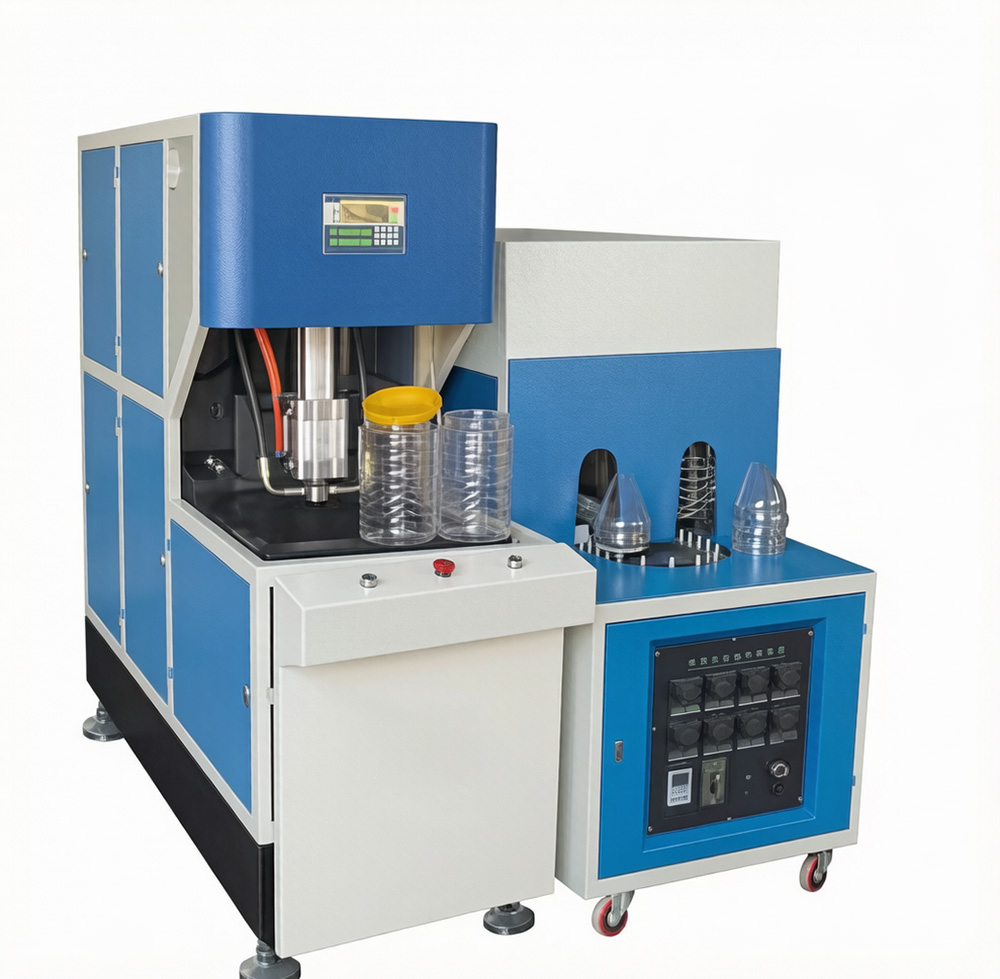
For stretch blow molding specifically, precise control over stretch rod velocity and blow pressure timing enables better material distribution in lightweight bottles. Bange Machine’s own all-electric PET blow molding platforms incorporate servo-driven actuation and high-pressure air recovery systems, achieving material and energy efficiency that hydraulic machines cannot match. The high-pressure air recovery system alone can save 50–60% of high-pressure air consumption, reducing compressor investment and operating cost [citation:13].
Bange Machine Engineering Note: The energy savings from all-electric blow molding are real, but they depend on proper machine sizing and configuration. An oversized all-electric machine running at low utilization may consume more total energy than a correctly sized hydraulic machine, despite being more efficient per cycle. The specification process must begin with the actual production profile—bottle sizes, cavity counts, cycle time targets, and utilization—not with a generic “all-electric is better” assumption.
Trend 2: AI Quality Control and the rPET Challenge
The second major trend is the integration of artificial intelligence into quality control and process management. This is being driven by a specific technical problem: recycled PET (rPET) introduces variability that traditional process control cannot manage effectively.
Why rPET Demands Intelligent Control
rPET arrives at the blow molding machine with a broader intrinsic viscosity distribution, higher moisture content, and greater batch-to-batch variation than virgin resin. These differences manifest as inconsistent stretch behavior, variable wall thickness, and higher defect rates. The process window for producing acceptable bottles from rPET is significantly narrower than for virgin PET, and it shifts as material properties change during production [citation:3][citation:9].
Manual process adjustment cannot keep pace with this variability. An operator cannot measure wall thickness on every bottle and adjust oven temperatures and blow pressure in real time. By the time a defect is detected through sampling inspection, hundreds or thousands of out-of-spec bottles may have been produced.
AI-Powered Process Control Systems
The industry response has been the development of closed-loop AI process control systems that measure every bottle and adjust machine parameters automatically. Agr’s Process Pilot+ incorporates AI that enables operators to automatically optimize the blowmolder based on performance, energy efficiency, or operating costs. The system continuously measures material distribution on every bottle and proactively manages optimal material distribution despite environmental, machine, and material variations—especially those caused by rPET [citation:3][citation:9].
Krones’ Contiloop AI operates on a similar principle. It measures light transmission at up to 32 positions on every container exiting the stretch blow molder, combines this with ambient temperature, humidity, and preform temperature data, and automatically adjusts stretch blow parameters to maintain bottle quality. The system is specifically designed for the narrow process window of rPET and lightweight containers, compensating for variations that would otherwise require manual intervention [citation:10].
Agr’s Pilot Vision+ extends this capability to defect detection. The in-blowmolder vision system uses up to six cameras at multiple locations to detect random defects while simultaneously managing material distribution. It is specifically positioned for quality management of bottles containing high percentages of rPET [citation:9].
| System | Core Function | rPET-Specific Capability |
|---|---|---|
| Agr Process Pilot+ | Closed-loop material distribution control | Compensates for rPET material variability in real time [citation:3] |
| Agr Pilot Vision+ | In-blowmolder multi-camera defect detection | Designed for high-rPET bottle quality management [citation:9] |
| Krones Contiloop AI | AI process regulation via light transmission measurement | Maintains narrow rPET process window automatically [citation:10] |
The Operator Experience Transformation
AI is also changing how operators interact with blow molding machines. German builder BBM demonstrated a prototype AI-powered control system at K 2025 that allows operators to troubleshoot problems by typing or speaking a question—described by the company’s CTO as “like ChatGPT for blow molders” [citation:1][citation:12]. This addresses a real workforce challenge: experienced blow molding operators are increasingly difficult to recruit and retain, and the tacit knowledge they carry is not easily transferred to new hires.
An AI assistant that can interpret an alarm code, suggest probable causes, and guide the operator through a diagnostic sequence reduces the expertise barrier to reliable operation. It does not replace skilled technicians, but it extends their reach and reduces the frequency with which minor issues escalate into unplanned downtime.
Trend 3: Smart Factories and the Connected Blow Molding Line
The third trend is the integration of blow molding equipment into broader factory data ecosystems. This is not simply a matter of adding sensors and dashboards. It represents a shift in how production equipment is specified, operated, and maintained.
Data Architecture as a Specification Criterion
Modern blow molding machines are generating more data than ever: cycle times, energy consumption per cycle, mold temperatures, blow pressure profiles, vision inspection results, and maintenance counters. The value of this data depends on whether it can be extracted, contextualized, and acted upon.
Machine builders are responding with control platforms designed for connectivity. Bekum’s Control 8.0 system and Uniloy’s Uni-Smart control system both provide the interface and data infrastructure for Industry 4.0 integration [citation:1]. Krones’ Contiloop AI transmits measurement and regulation data to the company’s IIoT platform for further optimization and quality assurance [citation:10].
For processors, the practical question is not whether a machine has a data interface, but whether that interface supports the specific operational workflows the factory needs: OEE tracking, predictive maintenance scheduling, energy management, and quality traceability. A machine that produces data in a proprietary format that requires custom middleware to integrate with the plant’s MES is less “smart” than one that supports standard protocols and open APIs.
Predictive Maintenance and the Reduction of Unplanned Downtime
The most tangible near-term benefit of smart factory integration is predictive maintenance. Blow molding machines have wear components—clamping mechanisms, stretch rod bushings, valve seals, heater elements—that fail predictably if monitored correctly. Vibration signature analysis, servo motor current monitoring, and thermal profiling can detect the early stages of component degradation before they cause a production stoppage.
The data infrastructure required for this is not exotic. It requires sensors at the right locations, a control system that logs the data with sufficient resolution, and analytics that can distinguish normal variation from degradation trends. The barrier is not technology—it is the discipline to specify these capabilities at the procurement stage and the organizational commitment to act on the data once it is available.
Bange Machine Engineering Note: A “smart factory” is not created by buying smart machines. It is created by defining the data flows that support operational decisions, specifying equipment that can feed those flows, and building the processes to use the information. We work with customers to understand their existing MES/ERP environment and production management practices before recommending the control and connectivity configuration for a new blow molding line. The goal is not maximum data volume. It is decision-relevant data delivered to the right person at the right time.
Implications for Equipment Investment Decisions
The three trends described above are not independent. All-electric machines provide the precise actuation that AI process control requires. AI process control generates the data that smart factory systems consume. And smart factory integration creates the feedback loop that makes continuous improvement possible. For processors evaluating blow molding equipment purchases in the 2026–2030 window, the implications are practical.
All-Electric Is Becoming the Default, Not the Premium Option
The energy and precision advantages of all-electric architecture are compelling enough that hydraulic machines are increasingly difficult to justify for new PET blow molding installations, except in specific niche applications or where capital budget constraints are absolute. The total cost of ownership calculation, including energy, maintenance, and scrap reduction, favors electric platforms in most production scenarios [citation:1][citation:6].
rPET Readiness Must Be Specified, Not Assumed
A machine marketed as “rPET capable” may simply mean that it can run recycled resin without immediate mechanical failure. That is not the same as being engineered for stable, high-yield production with variable recycled feedstock. The difference lies in the process control system’s ability to compensate for material variation, the heating system’s precision, and the vision system’s capacity to detect the defects that rPET tends to produce. Processors should request documented performance data from rPET trials, not just a capability statement.
Connectivity Should Be Evaluated Against Existing Factory Systems
The value of a smart machine is realized only when its data integrates with the plant’s operational systems. Before selecting a machine, map the existing MES, ERP, and quality management platforms and determine what data formats and protocols they support. A machine with a proprietary, closed data interface may require significant additional investment to deliver the promised “smart factory” benefits.
Bange Machine’s Position in the Technology Transition
Bange Machine is a Chinese manufacturer of PET blow molding machines with 11 years of production experience, serving customers in over 50 countries across Europe, the Americas, East Asia, and the Middle East [citation:2]. Our product range includes fully automatic PET bottle blowing machines, wide-mouth container blow molding systems, and bottle mold tooling.
We are not a developer of AI software or factory-level MES platforms. Our role is to build the machine platform that these technologies depend on: precise, reliable, and energy-efficient blow molding equipment with the actuation accuracy and control architecture that modern process control requires. Our all-electric and hybrid-electric platforms incorporate servo-driven motion control, high-pressure air recovery, and infrared heating systems optimized for uniform preform temperature distribution—the physical foundation on which any AI control layer operates.
For processors making equipment decisions in the current technology transition, we offer a pragmatic perspective: the machine you purchase today should be capable of operating efficiently as a standalone unit, while providing the control interfaces and mechanical precision to support future integration with quality management and factory data systems. That is the specification standard we build to.
Bange Machine is a Chinese manufacturer of PET blow molding machines and molds. Contact our engineering team to discuss equipment specifications for your production requirements and technology roadmap.